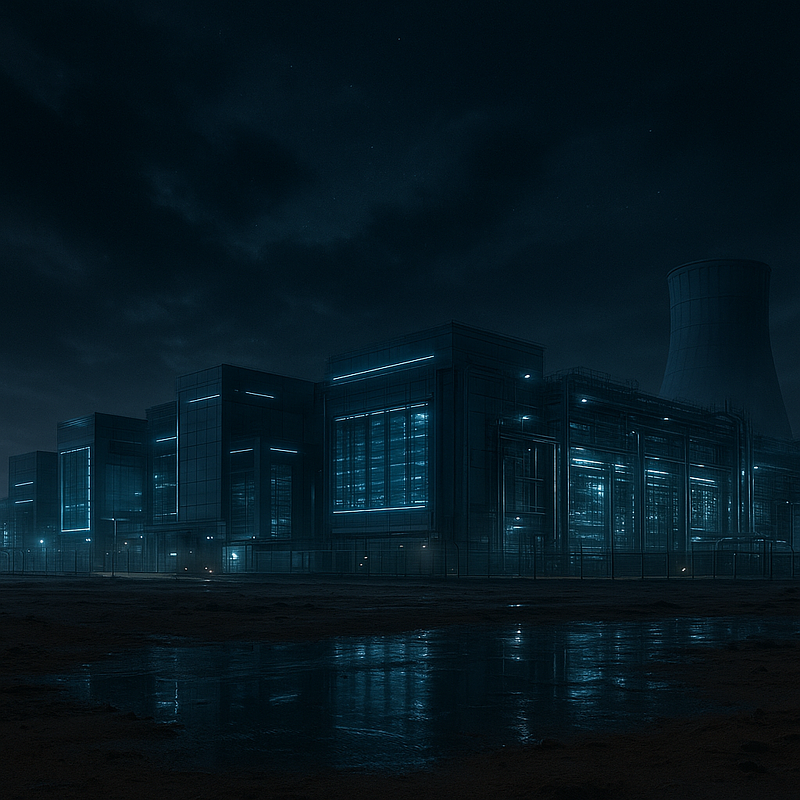
On April 3, 2026, a spokesperson for Iran's Islamic Revolutionary Guard Corps (IRGC), Brigadier General Ebrahim Zolfaghari, released a video directly threatening the "complete and utter annihilation" of U.S. and Israeli facilities in the region. The $30 billion Stargate data center in Abu Dhabi — OpenAI's largest international AI infrastructure project — was singled out by name.
The video displayed satellite imagery of the facility with the caption: "Nothing stays hidden to our sight, though hidden by Google," followed by night-vision footage showing the full scale of the sprawling campus.
This is not an empty threat. Over the preceding month, Iran reportedly struck Amazon AWS data centers in Bahrain and the UAE, as well as Oracle facilities in Dubai — the first time in recorded history that a state has deliberately targeted commercial data centers in an active military campaign.
Stargate Is Two Projects: American and Middle Eastern
Understanding the situation requires distinguishing between two geographically separate components of the Stargate program.
Stargate USA — $500B, Texas and Beyond
The core Stargate project is a $500 billion American infrastructure initiative announced in January 2025 at the White House. The flagship campus is already operational in Abilene, Texas, running on Oracle Cloud Infrastructure with Nvidia GPUs. Additional sites have been announced in Shackelford County (Texas), Doña Ana County (New Mexico), Lordstown (Ohio), Milam County (Texas), and Wisconsin.
The program has reached 7 GW of planned capacity and over $400 billion in committed investment. Key partners: OpenAI (operations), SoftBank (financing), Oracle (infrastructure), MGX (investment). Technology partners: Nvidia, Microsoft, Arm.
U.S. Stargate sites are not affected by the Middle East conflict. They are located on American soil and protected both physically and legally.
Stargate UAE — $30B, Abu Dhabi
The international expansion — a campus spanning approximately 19 square kilometers of desert south of Abu Dhabi, built and financed by UAE AI company G42, jointly operated by OpenAI and Oracle. The first phase — a 200 MWcompute cluster powered by Nvidia Grace Blackwell GB300 systems — was scheduled to come online by late 2026, scaling to 1 GW at full build-out.
This is the facility Iran has specifically named as a target.
What Has Already Happened: The Data Center Strike Precedent
The threat against Stargate UAE did not emerge from nowhere. Over the past month of conflict, Iranian strikes have reportedly damaged Amazon AWS data centers in Bahrain and the UAE, forcing them to scale back operations. The simultaneous disruption of two AWS "availability zones" caused standard backup systems to fail, forcing businesses to migrate data outside the Gulf region. Oracle facilities in Dubai Internet City also sustained damage.
The IRGC has additionally threatened Nvidia, Microsoft, Apple, Google, and 14 other U.S. technology companies.
Analysts note that these strikes established a precedent — the first state-directed military attacks on commercial data centers in modern history. This makes the current threat against Stargate considerably more credible than standard geopolitical posturing.
Impact on Nvidia and the GPU Market
Nvidia is the key technology partner for both the U.S. and UAE Stargate projects. Nvidia Grace Blackwell GB300 systems form the computational backbone of the Abu Dhabi facility.
In a positive scenario (conflict does not escalate to direct strikes on Stargate UAE), the impact on Nvidia is limited to delivery delays and potential timeline revisions for Middle Eastern capacity. GPU demand remains at record levels, and the majority of infrastructure is being built on U.S. soil.
In a moderately negative scenario (Stargate UAE is damaged but the conflict does not expand beyond the region), consequences include disrupted international expansion timelines, rising insurance premiums for Gulf projects, and reallocation of GPU orders to U.S. and European sites. For Nvidia, this is more a redistribution of demand than a reduction.
In a worst-case scenario (full-scale escalation with strikes on multiple technology infrastructure targets across the Gulf), the implications for the industry become significant.
Worst-Case Scenario: What Happens to the AI Market
If the conflict results in the destruction or prolonged shutdown of major data centers in the Gulf, the effects would ripple across the entire AI value chain.
Compute capacity shortage. The Gulf was, until 2026, projected to be the world's fastest-growing data center market, with annual growth rates exceeding 60%. Losing the region as a platform for AI infrastructure creates a capacity gap that cannot be quickly compensated.
Rising GPU and server equipment costs. Nvidia, AMD, and server manufacturers are already operating near capacity limits. If gigawatt-scale projects in the UAE and Saudi Arabia are frozen, GPUs earmarked for these sites would be redirected to other regions, but the overall expansion pipeline would slow. Prices for Nvidia H200, B200, and GB300 chips could rise.
Investor reassessment of risk. According to TD Cowen, hyperscaler capital expenditure in 2026 will exceed $600 billion, with roughly three-quarters tied to AI infrastructure. If a significant portion of these investments is exposed to geopolitical risk, investors will reassess valuation multiples for all AI-infrastructure-linked companies.
Insurance and credit consequences. Insurers and institutional lenders are already revising risk models for Middle Eastern infrastructure. Data center insurance premiums in the region could multiply, rendering some projects economically unviable.
Cascading effects on AI companies. OpenAI, which was counting on Stargate UAE as its largest international compute expansion, would lose a critical resource for training and deploying models. This could affect IPO timing, company valuation, and competitive positioning against Anthropic and Google.
Nvidia wins in every scenario — with caveats. GPU demand will not disappear; it will shift to the U.S., Europe, and other regions. However, construction delays, rising energy costs, and logistical complexities could slow Nvidia's revenue growth in H2 2026.
Companies Exposed
The situation affects a broad set of major technology and investment firms: OpenAI, Oracle, SoftBank, MGX, Nvidia, Microsoft, Arm Holdings, Cisco, AMD, Broadcom, Amazon (AWS), Google, Apple, and Meta — all of which have either direct participation in the Stargate project or infrastructure in the Gulf, or both.
For pre-IPO AI investors, this introduces an additional risk factor that must be weighed when constructing a portfolio.
What Investors Should Do
The situation reinforces several principles relevant to any AI-sector investor.
Geographic diversification matters. Companies with infrastructure predominantly on U.S. soil (U.S. Stargate, CoreWeave, Lambda Labs) are less exposed to Middle Eastern geopolitical risk.
The infrastructure layer remains foundational. Regardless of which scenario unfolds, demand for GPUs, server equipment, and AI compute capacity will continue to grow. Companies that control this layer (Nvidia, Groq, Lambda Labs) retain a structural advantage.
Diversify across AI segments. A portfolio spanning different layers of the AI stack — models (OpenAI, Anthropic), infrastructure (Nvidia, Groq), and applications (Scale AI, Replit) — is more resilient to localized shocks.
Monitor the conflict. Key indicators: ceasefire negotiation status, new strikes on regional infrastructure, and hyperscaler decisions to relocate capacity.
The AMCH portfolio includes leading AI companies across stages — from infrastructure to applications. Access to carefully selected pre-IPO deals with strategic diversification is available at: amcapital.app
This information is provided for informational purposes only and does not constitute individual investment advice. AMCH is not a broker or a trust management service. The company operates as an investment fund. Investments carry risks.