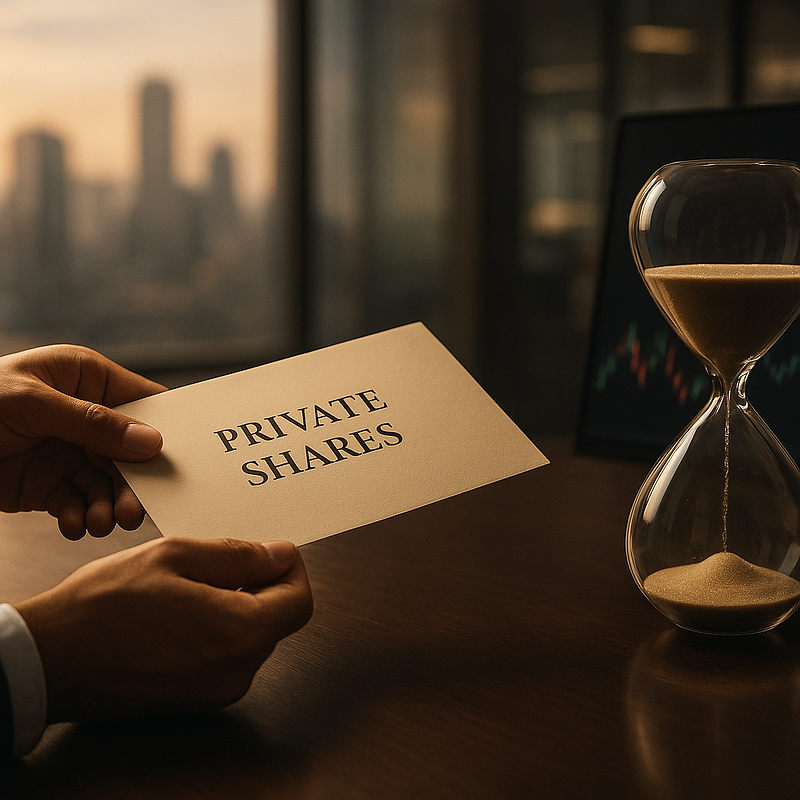
The lock-up period is the timeframe after an IPO during which insiders and early investors cannot freely sell their shares. For the market, this serves as an important stabilizer because it prevents immediate selling pressure.
When the lock-up expires, the market observes not only the technical increase in free float but also the behavior of existing shareholders: whether they sell en masse or maintain confidence in the business.
For private investors, this provides another signal about post-listing liquidity. Sometimes, the end of the lock-up reveals a company's true strength.
## How Private Shares Are Sold Before an IPO. Pre-IPO private share sales typically occur through secondary markets, tender offers, direct deals, or organized partial position sales before exchange listing. For investors, this offers early access to companies, but the price, structure, and seller motivation matter more than early entry alone.
## Why This Market Is Interesting. Often before an IPO, it becomes evident which issuers have gained real traction versus mere hype. Secondary markets reveal how current holders value assets compared to revenue data, growth rates, and competitive positioning—offering a more dynamic picture than theoretical presentations.
## Key Risks to Note. The first risk is overpaying due to scarcity premium. The second is failing to understand why the seller is reducing their position. The third is mistaking limited liquidity for quality. In pre-IPO deals, remember: access to rare assets doesn’t guarantee favorable pricing.
## What to Evaluate Before Buying. Assess business quality, development stage, competitive landscape, product-market fit, and liquidity scenarios. If a company hasn’t proven it can scale revenue without constant capital infusion, pre-listing investment risk increases. A strong pre-IPO asset isn’t just 'pre-IPO' but 'pre-IPO with clear economics'.
## The AMCH Approach. We evaluate such deals through the lens of price, maturity, and projected future demand. Rarity alone is insufficient. We need clarity on what the company has achieved and its post-listing potential.
## Conclusion. Selling private shares pre-IPO is a viable tool for investors who understand they’re buying future market potential—not status. Crucially: don’t confuse early access with favorable pricing.
Author: Arthur D · Scheduled for 2026-06-12
How Private Shares Are Sold Before an IPO
Dem Markt voraus sein
Erhalten Sie die neuesten Venture-Capital- und Investment-Einblicke direkt in Ihr Postfach.