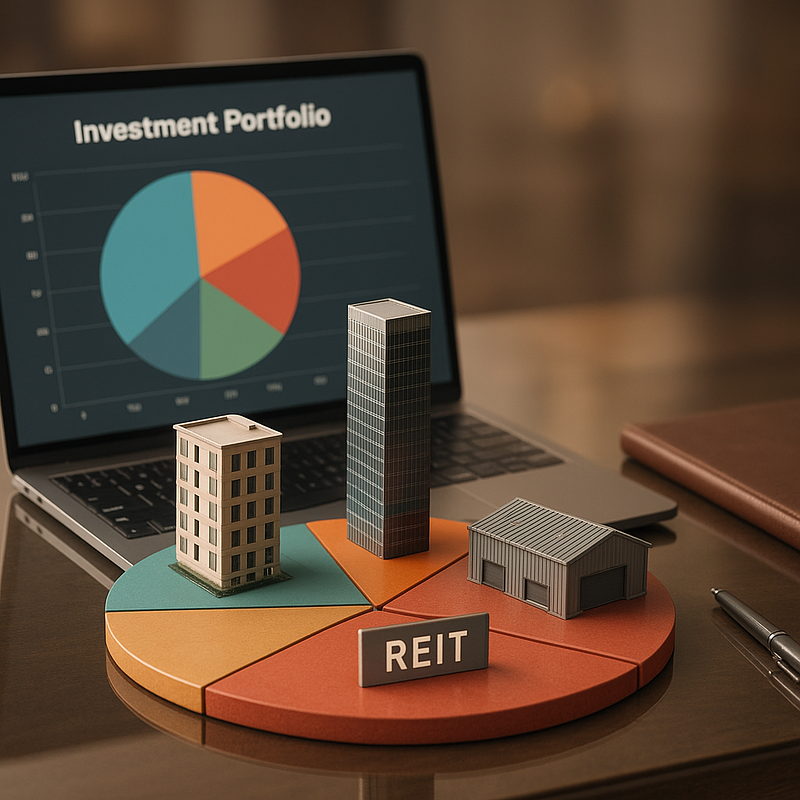
Real estate is often viewed as a defensive asset, but in private strategies, it functions not on its own but as part of the overall portfolio structure. Key considerations include the asset's liquidity, jurisdiction, rental income stream, and management quality.
For investors, the crucial question is what role real estate serves: capital preservation, stable income generation, or diversification from riskier assets. Without this clarity, comparing it to other asset classes is meaningless.
Under AMCH logic, real estate isn't just bricks and mortar but a risk distribution tool. It adds value when integrated into the portfolio rather than purchased for a false sense of security.
Diversification allocates capital across different instruments so portfolio performance isn't tied to a single risk source. Here, real estate holds a unique position: it behaves differently than stocks, bonds, or money markets, thereby smoothing overall return fluctuations. Investors also often perceive real estate as tied to the real economy rather than just market sentiment.
Moreover, real estate isn't monolithic—it's an entire asset class. Portfolio practice typically distinguishes residential, commercial, warehouse, office, and hotel properties, plus indirect exposure through funds, REITs, and development projects. Each category responds differently to rates, demand, inflation, and business activity. Thus, diversification benefits stem not from merely owning real estate but from the specific segment chosen.
Residential real estate often correlates with stable demand—people always need housing—but its returns are typically capped by rental rates and local price dynamics. Commercial properties may yield higher cash flow but depend heavily on tenant business health. Warehouses and logistics assets recently gained momentum from e-commerce growth, while office segments remain sensitive to shifting work models and occupancy rates.
For private investors, entry method matters. Direct purchases offer high control but require substantial capital, management time, and acceptance of low liquidity. Alternatives like funds and exchange-traded instruments provide real estate exposure without direct ownership. This format suits those adding real estate as a distinct risk-return layer without concentrating capital in one building or city.
From a portfolio perspective, real estate's utility lies in its partially distinct drivers from stock markets. Rental payments, vacancy rates, financing costs, and local demand create their own cycle. Real estate can sometimes hedge against inflation—rents and replacement costs may rise—though this isn't guaranteed and varies by market and asset structure.
However, real estate carries significant risks. First, low liquidity: selling quickly at fair value is challenging. Second, high sensitivity to interest rates makes leverage critical. Third, asset-specific risks include location, management quality, tenant stability, and regulations. Finally, returns often appear stable only until major repairs, vacancies, or market cycles shift.
Thus, real estate works best not as a universal substitute but as one component of a balanced portfolio. Its role is to add geographic, sectoral, and structural diversification plus potential cash flow. This approach requires comparing expected returns alongside liquidity, volatility, currency exposure, holding costs, and exit scenarios. Only then does real estate become a purposeful investment element—not a passing trend.
## How to Use Real Estate for Diversifying an Investment Portfolio. Real estate is often seen as a "tangible" asset, but its portfolio value lies in income structure and cyclical behavior—not simplicity. It can provide rental cash flow, inflation protection, access to physical assets, and added diversification if not treated as the sole capital allocation.
## Why Real Estate Aids Diversification. It follows different dynamics than public stocks or venture assets. Returns often combine price appreciation and operational flows: rent, occupancy, asset management, cost optimization. This helps smooth volatility, especially if a portfolio is overexposed to high-risk growth stories.
## Effective Formats. Options include direct ownership, project stakes, real estate funds, warehouse assets, offices, mixed-use properties, residential/commercial rentals. Each carries unique risk profiles—varying operational complexity, liquidity, and management/location importance. Mistaking all real estate as homogeneous is an error.
## Key Pre-Investment Factors. First: location and demand. Then: tenant quality, lease terms, vacancy rates, maintenance costs, taxes, and exit strategy. Also assess income reliance on cheap financing—and the impact of rising rates. Real estate appears stable only until market conditions or debt burdens change.
## Common Mistakes. First: buying for perceived safety rather than quantitative merit. Second: ignoring liquidity and holding periods. Third: overestimating price growth while underestimating operational expenses. Real estate excels when integrated into capital architecture—not when bearing all return expectations.
## The AMCH Approach. We view real estate as a system component: how it affects risk, cash flow, and exit horizons. It fulfills its purpose if it strengthens—not merely weighs down—the portfolio. Otherwise, it's concentration disguised as diversification.
## Conclusion. Real estate genuinely diversifies portfolios—but only when selected as a structural tool, not a security symbol. Its value lies not in the myth that "bricks always appreciate" but in clear asset economics and disciplined management.
How to Use Real Estate for Diversifying an Investment Portfolio
बाज़ार से आगे रहें
नवीनतम वेंचर कैपिटल और निवेश अंतर्दृष्टि सीधे अपने ईमेल पर प्राप्त करें।